 Convexfinance
 CVX locking uses weekly epochs to set voting weight and CVX release dates
Convexfinance CVX locking commits CVX to a locker that records voting weight and a scheduled release time. In the Ethereum mainnet V2 locker, a fresh position gains voting weight at the next weekly epoch and expires 16 weeks after that boundary. The total commitment therefore includes the wait before activation. Eligible locked CVX can influence Curve and f(x) Protocol gauge allocations and participate in administrative proposals. It also earns a share of platform fees. Ordinary CVX staking has flexible withdrawals and a different revenue share. Within a lock, voting eligibility, reward accrual, and principal withdrawal follow different rules.
Updated -Relocking expired CVX in the V2 locker can restore current-epoch weight, while a fresh deposit starts contributing in the next epoch.
Locked CVX connects the locker to protocol voting
CVX supplies the commitment, the locker keeps the account’s dated records, and the voting system reads the eligible balance. That voting balance, known as vlCVX or vote-locked CVX, measures the locked position that can participate in governance. The account’s CVX commitment follows its release schedule; voting weight describes the influence attached to that position.
Convex holds veCRV voting power for Curve and veFXN voting power for f(x) Protocol. Locked CVX holders influence how the platform uses those positions through the relevant votes.
CRV boosting applies pooled veCRV to eligible liquidity-provider rewards. A CVX lock supplies governance influence over emissions that reward those positions.
Gauge allocations and administrative proposals follow different paths
Gauge-weight voting allocates influence among eligible reward gauges, while administrative voting addresses protocol proposals. Curve uses gauges to track liquidity positions that share CRV rewards, and a gauge’s assigned weight helps determine its emissions. The CVX locking interface identifies Curve and f(x) Protocol gauge-weight votes, together with administrative proposals for Curve, f(x) Protocol, Frax, and Convex. These governance functions have their own proposals and eligibility rules.
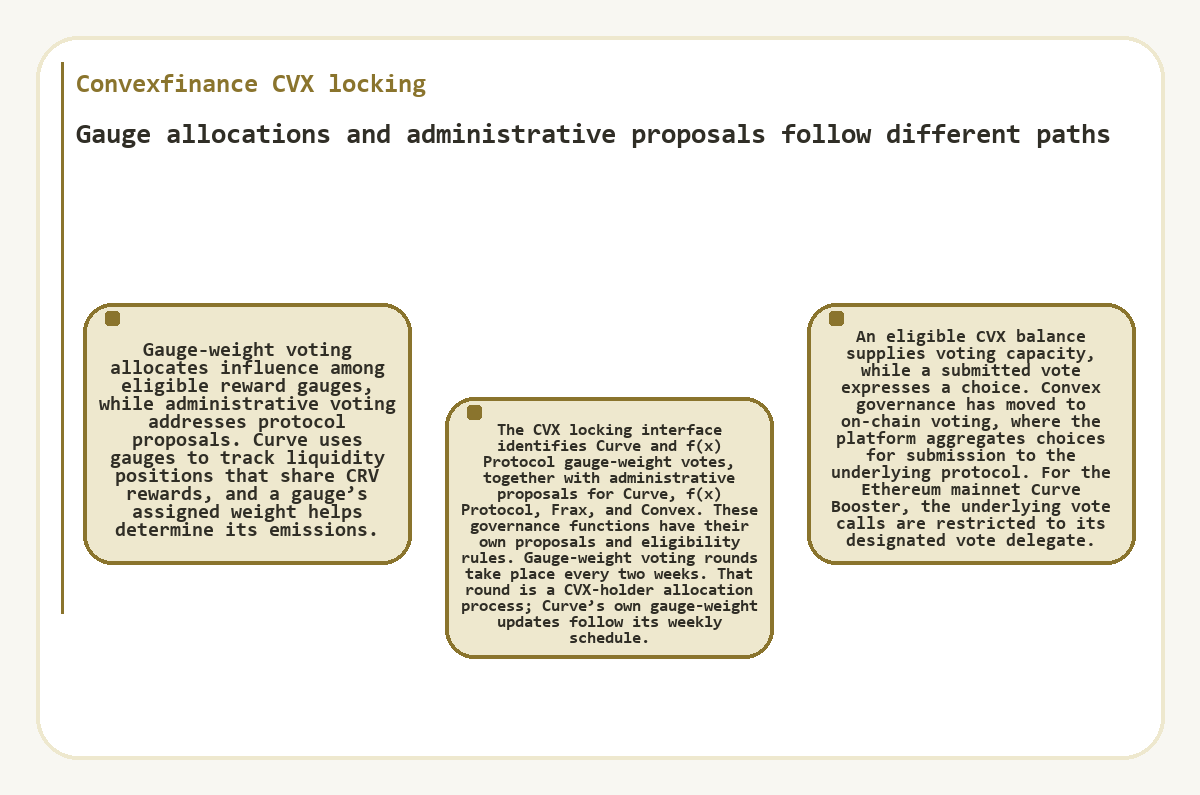
Gauge-weight voting rounds take place every two weeks. That round is a CVX-holder allocation process; Curve’s own gauge-weight updates follow its weekly schedule. An eligible CVX balance supplies voting capacity, while a submitted vote expresses a choice. Convex governance has moved to on-chain voting, where the platform aggregates choices for submission to the underlying protocol. For the Ethereum mainnet Curve Booster, the underlying vote calls are restricted to its designated vote delegate.
Voting weight remains stable within an eligible lock
A V2 lock contributes its full eligible weight until expiry, without gradual decay as the remaining lock time decreases. With no optional boost payment, that weight matches the CVX amount locked. The contract sums the locks that qualify for the relevant epoch. A newly created lock enters a pending voting period before it joins the current voting balance. Once a lock expires, its contribution drops out of current voting weight, even if the CVX remains in the locker.
An open proposal can use an earlier epoch’s balance, so the locker’s current total alone does not establish the available weight. The proposal’s epoch and its balance-reading rules determine that answer.
How is a fresh CVX lock’s expiry calculated?
Fresh V2 locks expire 16 weeks after the next weekly epoch begins. Weekly locking epochs start on Thursday at 00:00 UTC, and the initial wait adds to the commitment. Execution just before the boundary produces a commitment close to 16 weeks; execution earlier in the week adds more waiting time.
A display of 16 weeks plus 2 days describes a timing case, with the extra wait determined by the lock transaction’s block timestamp. The V2 contract stores an unlock timestamp for the lock. That timestamp determines normal withdrawal eligibility; a countdown presents the remaining time.
Platform fees and voting incentives remain separate
Locked CVX earns a share of platform fees through the locker’s reward accounting. Claimable rewards form a separate balance from the CVX principal, and claiming them does not shorten an unexpired lock. Ordinary CVX staking distributes a different revenue share and permits withdrawals at any time. Staking and vote locking therefore create distinct positions, even though both use CVX. A fresh V2 lock can accrue funded rewards before its voting weight activates. Accrual uses the account’s locked or boosted balance, depending on the reward token; the duration does not set a fixed return.
Votium and VoteMarket provide third-party incentives for voting on incentivized pools, adding a further reward source beyond platform fees. The offered incentives belong to the relevant voting round and pool. Voting weight grants participation capacity; it does not specify an incentive amount or a future percentage return.
A fresh deposit and a relock have different activation times
Consider a hypothetical comparison of two 375 CVX positions halfway through a weekly epoch, with 3.5 days until the next boundary. One position is a fresh deposit, and the other consists of expired CVX being relocked. Neither uses an optional boost payment, and neither account has another lock.
The fresh deposit has zero current-epoch voting weight and adds 375 vlCVX units from the next epoch. Its normal expiry arrives 115.5 days after execution: the 3.5-day wait plus the 112-day lock period. The relock allocates 375 vlCVX units to the current epoch and expires 108.5 days after execution, because that epoch began 3.5 days earlier. Both positions contribute their full weight during their eligible epochs.
A vote using an earlier epoch evaluates the position at that epoch. The displayed current balance does not replace that historical balance.
What changes when an expired CVX position is relocked?
Relocking an expired V2 balance assigns its voting weight to the current epoch. The operation creates a new release schedule based on the beginning of that epoch. A withdrawal sends matured CVX out of the locker instead of renewing its commitment.
The V2 expiry-processing operation handles eligible expired balances, withdrawing or relocking them within one operation. Unexpired positions remain committed, so an account can hold matured CVX alongside positions with later release dates.
Expired balances can keep earning platform fees while they remain unprocessed, although they no longer add current voting weight. After the configured grace period, another account can kick eligible expired locks out of the locker. That caller receives a portion of the expired CVX, reducing the amount returned to the holder. The grace period and kick incentive are governance-adjustable settings.
Relocking does not itself claim accrued rewards. The locker keeps those rewards in its reward accounting for a separate claim.
Approvals, account control, and lock-specific limits
A CVX approval sets the ERC-20 spending allowance that the locker can use. The locking operation uses that permission to transfer CVX and create the account’s lock record. In the standard interface, any required approval transaction must confirm before the Lock CVX action. The confirmed lock supplies the amount and release schedule; an allowance alone supplies no locked principal.
The V2 locker runs on Ethereum mainnet, where transaction fees are separate from the CVX amount committed. Normal access to the CVX principal follows its recorded expiry.
An owner-triggered V2 shutdown is a specific exception: it stops new locks and makes outstanding positions withdrawable. A holder cannot invoke that administrative exception as an ordinary early exit. Before renewing an expired position, compare its new unlock time with when the CVX itself must be available.
Convexfinance CVX locking questions worth asking
Can a vlCVX balance be transferred between wallets?
vlCVX cannot be transferred between wallets like an ordinary ERC-20 token. Its balance comes from the account’s lock records and eligible epochs. The V2 locker exposes balance-reading functions for voting tools, but it does not provide ordinary token-transfer functionality. Moving voting authority through delegation leaves the CVX lock attached to its existing account.
Does a later CVX deposit reset the expiry of an earlier lock?
A later fresh deposit does not reset the expiry of an earlier weekly lock. Fresh deposits within the same epoch share an unlock time and can combine in one record. A deposit in a later epoch receives a later expiry. The account can consequently hold several lock groups with different release dates.
Why can an on-chain CVX vote revert with ExpiredLocks?
ExpiredLocks identifies an unprocessed expired position encountered by the dedicated on-chain voting implementation’s delegation synchronization. Voting can invoke that synchronization when it needs to update recorded weight. The affected expired balances must be processed through withdrawal or relocking before synchronization can succeed. A fresh lock awaiting its activation epoch is a different state.
Must a contract-held CVX lock implement EIP-1271 for every voting method?
EIP-1271 is a contract-signature option for Snapshot participation; it is not required for every CVX voting method. A contract holding vlCVX can participate in Snapshot through delegation to an externally owned account or through EIP-1271 signature support. The dedicated on-chain voting implementation authenticates the voter address or its registered surrogate directly, without that signature standard.
Is automatic cvxCRV staking required when claiming CVX-locker rewards?
The V2 locker supports claiming rewards without staking the cvxCRV portion. Its claim function can pay the reward tokens to the account or, with the staking option selected, stake cvxCRV for that account. Other reward tokens still go to the account. That option changes the destination of the cvxCRV reward and leaves the CVX lock’s expiry unchanged.
How does changing an on-chain vote delegate affect the current epoch?
A delegate change in the dedicated on-chain Delegation contract takes effect from the next epoch, leaving current-epoch delegation unchanged. Synchronization updates the weight recorded after a lock change and has different timing. Changing who votes and updating the recorded weight are separate operations.